
What Our Nursing Concept Map Help Includes
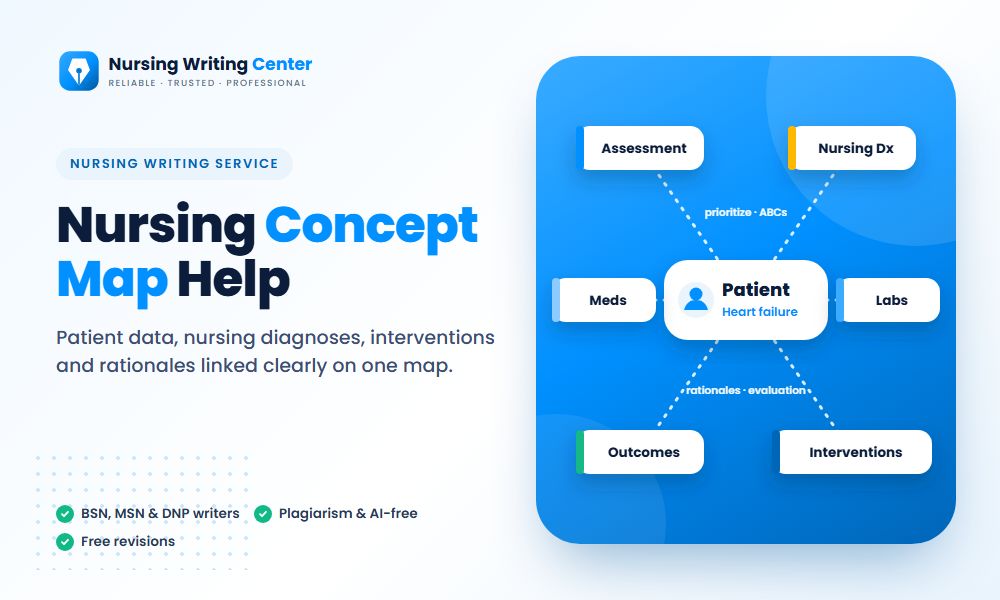
Each map is built from your patient data and your instructor’s template, and delivered as a file you can edit and print. A complete care plan concept map from our writers includes:
- The central concept: your patient or primary medical diagnosis, with age, reason for admission and relevant history
- Assessment clusters: subjective and objective findings, with abnormal labs and vital signs flagged against reference ranges
- Pathophysiology: a short explanation of how the disease produces the findings you saw at the bedside
- Medications: each drug linked to the problem it treats, with the key nursing considerations
- Prioritized nursing diagnoses: usually three to five, each supported by your patient’s own data
- Goals, interventions and rationales: measurable goals, specific interventions and a cited rationale for each one
- Evaluation: whether each goal was met, partly met or not met, and what you would change
How We Build a Care Plan Concept Map
Our writers follow the same clinical reasoning your instructor is grading. It lines up with the six steps of the NCSBN Clinical Judgment Measurement Model behind the Next Generation NCLEX, so a well-built map doubles as exam practice:
- Recognize cues: we sort your assessment data and pick out what is abnormal, changing or unexpected.
- Analyze cues: we cluster related findings, for example crackles, a falling oxygen saturation and weight gain, and link them to the disease process.
- Prioritize hypotheses: we name the nursing diagnoses and rank them by the ABCs, Maslow’s hierarchy and safety, so airway, breathing and perfusion problems come before knowledge deficits.
- Generate solutions: we set a measurable goal for each diagnosis, with a time frame.
- Take action: we choose specific interventions, each with a frequency and a cited rationale.
- Evaluate outcomes: we state the evidence that shows whether each goal was met.
Stuck on this assignment?
A nurse-writer can start in 15 minutes. Chat with us on WhatsApp or order online.
Every connecting line on the map is labeled or explained in a short note, so your instructor can follow why one box leads to another instead of guessing. That explanation is often what separates an average map from a high-scoring one.
Concept Map, Care Plan or Pathophysiology Map?
Nursing programs use the words “concept map” for several different assignments. Check which one your rubric describes before you order:
| Format | What it shows | Usually assigned in |
| Care plan concept map | Patient data linked to prioritized nursing diagnoses, goals, interventions, rationales and evaluation | Clinical rotations and simulation |
| Pathophysiology concept map | A disease from its causes to the cellular changes, signs and symptoms, complications and treatment | Pathophysiology courses |
| Medication concept map | One drug or class with its mechanism, indications, adverse effects, interactions and nursing considerations | Pharmacology courses |
| Traditional care plan | The same nursing process set out in columns instead of a diagram | Courses that ask for a written or tabular plan |
We make all four. For an example of a deeper, graduate-level map, see our pathophysiology concept map on type 2 diabetes and kidney disease.
Mistakes That Lose Points on Nursing Concept Maps
Instructors mark down the same problems semester after semester. Our writers check every map for them before delivery:
- A medical diagnosis written as a nursing diagnosis, such as “pneumonia” instead of “Impaired gas exchange”
- Nursing diagnoses with no supporting data from the patient, or patient data that no diagnosis uses
- Every lab value listed, including the normal ones, which hides the findings that matter
- Vague interventions such as “monitor patient”, without what to monitor, how often and when to escalate
- Rationales with no source, or with sources older than your course allows
- Goals that cannot be measured, such as “patient will feel better”
- Lines between boxes with no explanation of how the two are related
Writing Nursing Diagnoses That Match the Data
Most concept map rubrics follow the NANDA-I format, and each kind of diagnosis is written differently:
- Problem-focused: the label, the related factors and the defining characteristics you observed, for example “Ineffective airway clearance related to retained secretions as evidenced by coarse crackles and an ineffective cough”.
- Risk: the label and the risk factors your patient has. The problem has not happened yet, so there are no defining characteristics, for example “Risk for falls, with risk factors of orthostatic hypotension, diuretic therapy and a new walker”. Schools word this differently, so we follow your course’s phrasing.
- Health promotion: the label and the patient’s expressed wish to improve, for example “Readiness for enhanced self-care”.
Every diagnosis must trace back to data elsewhere on the map. If the crackles and the weak cough are not in your assessment cluster, “Ineffective airway clearance” has nothing to stand on, and that is one of the first things an instructor checks.
Concept Maps for BSN, MSN and DNP Courses
At BSN level, a concept map usually covers one patient from a clinical day or a virtual simulation, such as a Shadow Health assessment or an i-Human case. Our heart failure concept map sample shows the typical scope: one older adult, three prioritized diagnoses and a full evaluation.
In MSN advanced pathophysiology and pharmacology courses, maps go further into mechanisms, such as the cellular changes behind diabetic kidney disease, and draw on current clinical practice guidelines. Some DNP courses use concept maps alongside fishbone diagrams to show how a practice problem, its root causes and a proposed change fit together before the DNP project proposal is written.
Whatever the level, send us the template, the rubric and de-identified patient data, and your writer will build a map that follows your course’s rules and shows your reasoning clearly.
Sample papers
See how our writers handle this kind of paper.
- Concept Map for an Older Adult With Acute Decompensated Heart FailureBSN
- Pediatric Concept Map: A School-Age Child With an Asthma ExacerbationBSN
- Pathophysiology Concept Map: Type 2 Diabetes and Kidney DiseaseMSN


